Sri Lanka.
The air is hot and suffocating. The southwest monsoon season has just begun, and rain is pouring down on the entire western coast, where the capital, Colombo, is located.
Tuktuks, the ever-present vehicles in Sri Lanka, zip through the streets, maneuvering in a ruleless jungle where the only imperative is to keep moving. I ask if the amount I have to pay, which is about 300 rupees (1 euro), is correct. The driver smiles at me, swaying his head in a gesture that confuses me: is it a yes, or a no? I will soon learn that this gesture denotes a lazy affirmation in the island’s body language. “Bohoma sthuthi,” I reply—”thank you”—and his smile widens even more, but it is only for a moment before he zips back into the chaotic Colombo traffic.
It is 4:30 in the morning, and I am heading to Galgamuwa with my colleagues. I am thrilled; this is my first “taste” of fieldwork. Before we head inland, we pass through the town of Negombo, where the presence of the Christian community is unmistakable, thanks to the numerous statues of saints posted at every street corner.
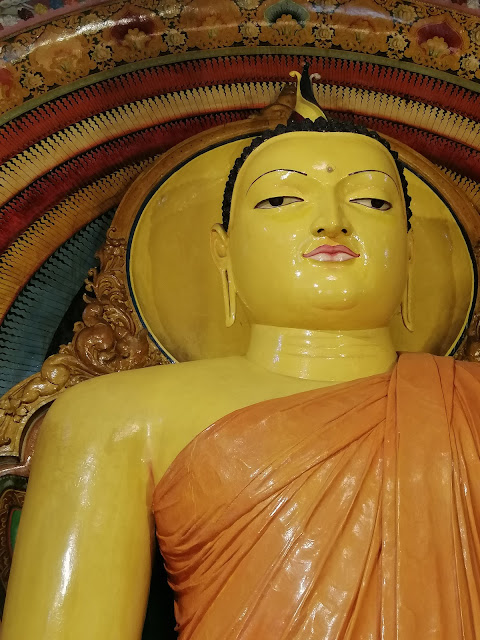
As we move away from the coast in our van, the landscape opens up into a green and lush expanse of palm trees, rice plantations, and the typical stupa, the white domes that distinguish Buddhist temples. We pass a large statue of the Buddha, whose languid gaze follows us through his half-closed eyes, fixed in a state of perennial meditation.
Along the way, we stop for a first, a second, and a third breakfast. Sweetened tea; badairingu, stewed corn on the cob; idiyappa, thin rice flour noodles served with sambal—a raw condiment made from grated coconut—and dhal, spiced lentils. Everything is eaten with your hands, including the rice and curry. My colleagues offer me a spoon, which I proudly and instinctively refuse. While they are very skilled and experienced, I try to imitate their technique by watching them out of the corner of my eye, but my attempt is just a pale imitation, and as I eat—or try to—I just hope that no one notices my pathetic and ungraceful attempts. In a few minutes, my mouth turns into a circle of hell, and I need a plain yogurt to soothe the burning sensation.
I ask R. what today’s training will be about. A community of local farmers is waiting for us. “The value of networking, of human relationships as an effective strategy to solve common problems,” he answers.
“Capital is not just money; capital is also social.”
I smile, thinking about and weighing the value of these words.
Sri Lanka is a small green island that was torn apart by a bloody civil war between 1983 and 2009. In this era of “post-conflict,” rebuilding the community is a challenge, especially in a context where three languages are officially spoken (Sinhala, Tamil, and English), four religions are practiced (Buddhism, Hinduism, Islam, and Christianity), and where society is multi-ethnic (the Sinhalese, who make up about 75% of the population, the Tamil minority, about 20%, and the remaining 5% consisting of other minorities). Rebuilding trust and cooperation, and above all, the reconciliation of civil society, is therefore essential to prevent conflict and guarantee sustainable peace.
In the conference room, the air conditioning hisses, creating an oasis of coolness from the tropical heat. There are about thirty people of different ages and a predominant majority of women with brightly colored clothes and faces weathered by the sun. They observe me with curiosity, and I return the sentiment. M., a young man with a round face, is my enthusiastic interpreter, since the entire training will be conducted in Sinhala and my vocabulary is still limited to a few phrases that I repeat like a mantra: mage nama Margherita, mage rata Italia, mama chutak sinhala katakaranava (my name is Margherita, I come from Italy, I speak a little Sinhala).
During the workshop, questions are asked about the difficulty of cultivating community in the face of external factors that can insinuate themselves into the group, thus fueling internal divisions: how to recognize such factors? How to prevent them? How to counter the divisions that undermine the strength of the community? During the training, the participants are gathered in small groups, where the debate ignites and their thoughts are then put in writing on large sheets of paper before moving on to the general discussion.
I follow the training with interest, becoming familiar with new concepts and current issues that afflict Sri Lanka, which I had not heard about before. With the help of M., who makes sure to provide me with clarifications during breaks, I jot down words on my phone that help me remember topics I would like to explore in the future, which are essential for understanding the context I am in. Like, for example, the so-called “human-elephant conflict,” which is the serious problem of coexistence between humans and elephants that affects many rural areas of the island and the Southeast Asian continent.
At the end of the day, I am exhausted; the constant translation and the preliminary memorization of new words, concepts, and topics, with which I still have to familiarize myself, have debilitated me. But I am happy and enthusiastic; after all, this is only the beginning. Before getting back into our van, we greet the participants by joining our hands in the typical Buddhist greeting: ayubowan, long life. The country roads we enter, mostly without lighting, are deserted and dark. From the window, I can only see the profiles of the tall palm trees at the edge of the road. Along the way, we stop for tea, which is extremely sweet, and it is served with the typical hopper, a bowl-shaped pancake that can be eaten sweet or savory.
I realize that we are approaching the city only from the first lights that begin to appear in the distance and from the profile of the tall hotels that are proliferating on the coast and near the port. We are returning to Colombo, to “home,” the place where life has led me and where I will stay, trying to cultivate community, for the next few years to come.